18 top things to do in Skopje, North Macedonia + top tips!

Skopje, the capital of North Macedonia, is a city of contrasts. When you visit, you’ll discover centuries-old landmarks sitting side by side with both Communist and post-Communist era architecture, with different experiences and sights that reflect this.
And the city’s location, just a few miles from the Matka Canyon, less than an hour from the border with neighbouring Kosovo, and within reach of Lake Ohrid – Europe’s oldest lake – makes it a perfect base for exploring the region.
Here you’ll find 18 top things to do in Skopje on a short break.
From exploring the old Ottoman bazaar, seeing the city’s collection of unique statues, learning about the city’s ancient and more recent history, to riding a boat through a canyon or a cable car up the local mountain, there’s something for everyone here.
This post contains affiliate links
Top things to do in Skopje, North Macedonia
Below you’ll find more information things to do in Skopje. These include the following top attractions and experiences.
Top things to do in Skopje
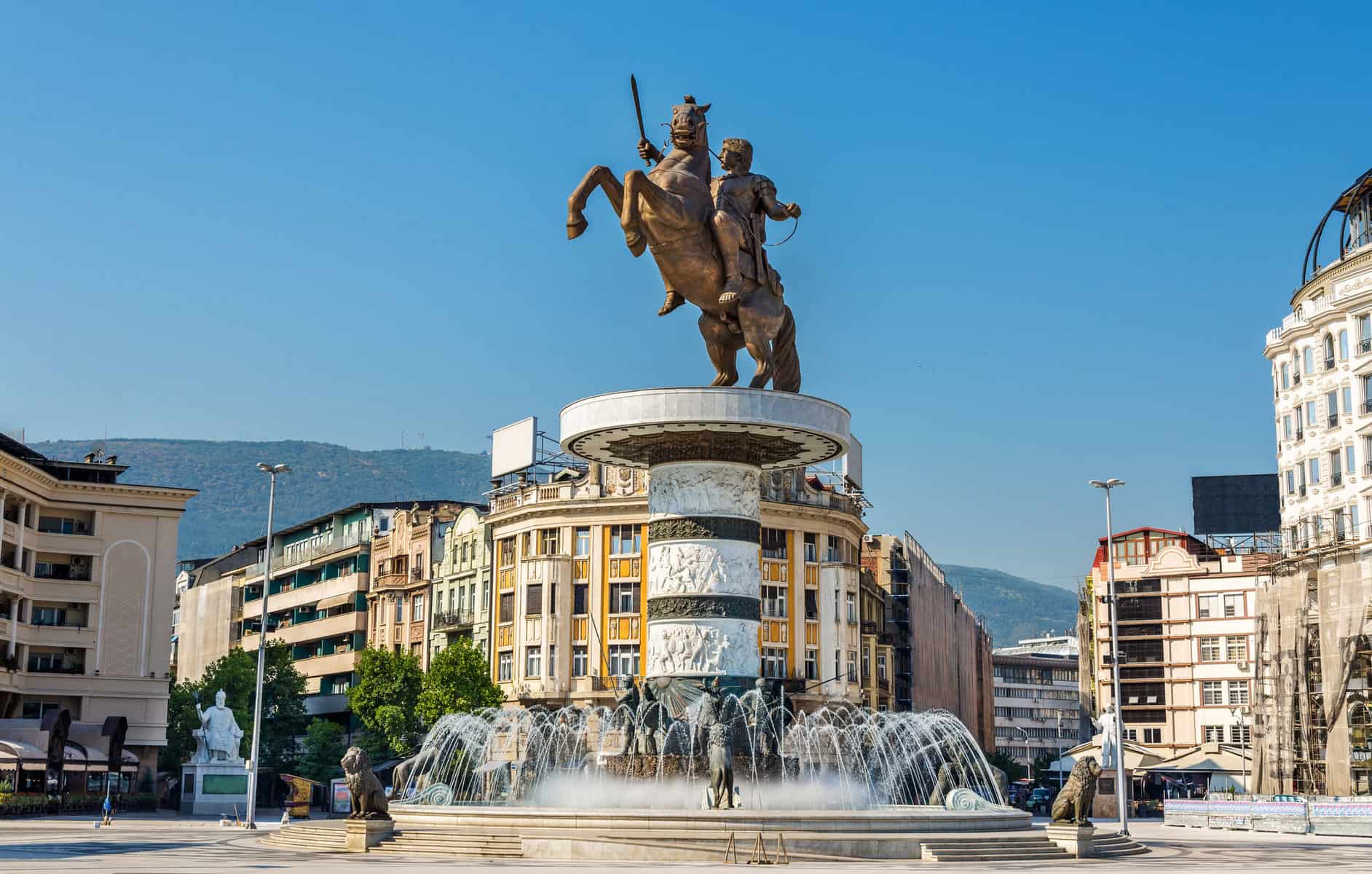
– Visiting Macedonia Square with its magnificent ‘Warrior on a Horse’ statue
– Seeing the city’s fascinating architecture and the buildings and structures introduced as part of the ‘Skopje 2014 Project’
– Strolling around the old bazaar and trying some of the local food
– Sailing through the Matka Canyon
– Riding a cable car up the city’s Mount Vodno
– Learning more about Mother Teresa
– Going into some of the city’s beautiful churches and mosques
– Taking in the views of the city from the Kale Fortress
– Learning more about the history of Skopje and North Macedonia
– Visiting Lake Ohrid, the oldest lake in Europe
– Sightseeing in nearby Kosovo
There’s also information below to help you plan your trip, including how to get to Skopje, how to get around, and the best time to visit.
Where is Skopje?
Skopje is the largest city in the Republic of North Macedonia (known before 2019 as the Former Yugoslav Republic of Macedonia).
It is a landlocked country in the Balkans region of southeastern Europe, sharing borders with Kosovo and Serbia to the north, Albania to the west, Bulgaria to the east, and Greece to the south. Because of this, it’s possible to book trips from North Macedonia to neighbouring countries, or to day trip from other countries to Skopje.
Skopje is in the northern part of the country. It lies along the Vardar River, which flows through the city centre.
How to get to Skopje
You can reach Skopje in several ways, depending on where you’re travelling from.
There are regular flights to Skopje airport from various places within Europe. These include London, Paris, Lyon, Belgrade, Nuremberg, Vienna, and Warsaw.
The airport is just over 20 kilometres from the city centre. This is served by a shuttle bus, and the journey takes around 40 minutes. Check the timetables, however, as they only seem to run every one and a half to two hours.
If the shuttle bus doesn’t work for you, you can also catch a taxi, but this will obviously be more expensive. I did this as my incoming flight arrived very late. I paid 30 euros for the journey.
You can also get to Skopje from neighbouring countries such as Kosovo, Serbia, Albania, and Bulgaria. Flixbus provides coach connections between some of these, although in some cases, the journeys are quite long.
The bus station in Skopje is just east of the downtown area, located on the right bank of the river. It is next to the train station, which also connects to other countries and various destinations within North Macedonia.
Organised tours
You can also get to Skopje on an organised tour.
This tour takes you from Sofia in Bulgaria to Skopje and includes a two-hour walking tour around some of the best places in the city. There’s also two hours of free time built into the itinerary, so you can also explore at your own leisure.
This tour goes from Tirana in Albania. Again, it covers the top things to do in Skopje and gives you the chance to learn about the city’s history and that of North Macedonia.
How to get around Skopje
Skopje is a very walkable city. Much of what you will want to see is in the city centre around the two sides of the Vardar River, so many things are within walking distance of each other. In many of the main areas – notably the old town and bazaar, Macedonia Square, and Macedonia Street – you will also need to get about on foot as these are pedestrianised.
However, some of the other top things to do in Skopje will require some transport to reach. This includes going up Vodno Mountain and visiting the Matka Canyon. In both cases, you can catch public transport and explore them independently.
Alternatively, there are organised tours that will take you to sights. If you are short on time, this might be the best option, especially as some tours combine the two.
For example, this tour, which I booked, includes going up the mountain on a cable car, and time in the Matka Canyon.
18 top things to do in Skopje
Below is an overview of the top things to do in Skopje, based on my recent short trip.
Visit Macedonia Square with its huge warrior statue
One of the first things you should do in Skopje is head to its main square, Macedonia Square, which sits on the right bank of the river.
It’s a big square, the largest in the country at over 18,000 square metres. It’s surrounded by a collection of grand neo-classical buildings, as well as more modern glass-fronted ones. Some of these house hotels and eateries.
Macedonia Square is connected to the old town via the Stone Bridge. On the other side, several streets, including the pedestrianised Macedonia Street, radiate off from it. This is lined with shops, cafes and restaurants and stretches up to the old railway station, which houses the City Museum.
The square has a real buzzy vibe. I sat outside on one of the restaurant terraces, having a drink and watching the world go by.
The ‘Warrior on a Horse statue’
When you’re in the square, you can look up at the massive statue in the centre of the square. It is 22 metres high and dominates everything else here. It is the ‘Warrior on a Horse’, a bronze statue atop a plinth that sits on a column. Fountains spurt up at its base.

The warrior is apparently Alexander the Great. However, controversy between North Macedonia and Greece led to a compromise name for the statue of ‘Warrior on a Horse’.
It is one of many that were erected as part of a regeneration project known as the ‘Skopje 2014 Project’. The plan was designed to bring a more Western European ‘feel’ to the city by upgrading some buildings with a more neo-classical style and introducing new structures. It built on the development that took place decades earlier, after Skopje suffered a devastating earthquake in 1963.
I’ve read and heard that views are divided on the statue (and on many of the others in the city, with labels such as ‘kitsch’ being used). But I really liked it, perhaps because it’s so huge and eye-catching.
At night, the lights from some of the buildings around the square douse it in colour, and it is particularly striking.

Top tip: Make sure you see Macedonia Square at night, as well as in the daytime. The statue is lit up in different colours and looks incredible.
Spot the city’s statues (there are loads!)
Given how many there are, one of the top things to do in Skopje is spot the statues that are dotted around. There are so many, it’s often referred to as the ‘City of Statues’.
Many are so large and eye-catching that you can’t miss them as you stroll around the city centre. A large number were introduced as part of ‘The 2014 Project’ which started in the early 2010s.
They include the ‘Warrior on a Horse’ statue in Macedonia Square, and the large statues of Philip II of Macedon and Mother of Alexander III of Macedonia in Crvena Skopska Opstina.

There are also numerous statues of figures from the past that sit along the riverbank, along some of the bridges, and around the sides of Macedonia Square. In addition, there are lion statues on a bridge, and a bronze bull on Luj Paster street!


Stroll around the old bazaar
Spending time in Skopje’s old bazaar is a must. It’s one of the main attractions in the city centre and is impossible to miss when you’re sightseeing.
It’s just off the plaza that’s connected to Macedonia Square by the Stone Bridge, and is not far from Skopje Fortress.
Dating back to the 12th century, the bazaar reflects the Ottoman period during which it flourished. There are mosques and minarets that you will see, as well as old hammams (some are now art galleries). I was told it’s now the second-largest operational bazaar in Europe.

Take a wander here and you’ll also see a good selection of shops, many selling jewellery, clothes, and shoes. In addition, there’s a generous choice of cafes and restaurants where you can try the local food and sit outside soaking up the vibe.


Some of these are the more traditional places you’d probably expect to see in an old town and bazaar. Others are more modern, serving cocktails you can grab before your evening meal.
At dusk, the lights hanging across the streets give it quite a romantic feel.
Top tip: Make sure you have some cash on you. Although many bars and restaurants in the Macedonia Square area take cards, many in the bazaar do not.
Sail or hike through the Matka Canyon
A trip to the Matka Canyon is one of the best things to do in Skopje and should definitely be on your sightseeing list if you have time. It’s a beautiful place and a good opportunity to get out of the city centre.

Matka is around 15 kilometres from the centre of Skopje. You can get there on the local bus (bus number 60) or as part of a tour, as I did. Check this out here.
The canyon is around 5,000 hectares in size and consists of limestone cliffs that rise up from the Treska River. When we arrived, we walked up a short slope, past a river dam, and then made our way around a path that follows the side of one of the cliffs.
At one point, there was a jetty offering boat trips, but we carried on to the second jetty (these are the boats to catch if you want to go into Vrelo Cave).
My boat trip
We jumped on one of the small wooden boats moored at the jetty and had a fantastic boat ride on the water through the canyon. This took just under half an hour. The views of different parts of the canyon were incredible, and we could look up at the cliffs and see some of the hikers who had continued on the pathway.

At the end of the boat journey, you can get out and go into Vrelo Cave, which is on the right bank of the river.
To get into the cave, you need to climb up some steep steps. It is only small, but it’s worth going inside to see the rock formations and the stalactites and stalagmites, some of which are illuminated.
We then returned by boat to the small village beside the gorge, where there is a small monastery and a restaurant. The restaurant is in a great spot, with seating in a prime spot overlooking the canyon, so is worth stopping in if you have time.
For more information on the tour I booked, click here.
It is free to get into the gorge, but if you want to take a boat trip, you will have to pay. I paid 500 denars for my boat trip (approximately £7/€8.10/$9.45).
You can also go kayaking (it was 200 denars to hire a single kayak for 30 minutes and 300 denars for 60 minutes when I was there), swim, or go hiking.
Top tip: If you plan to hike through the gorge or enter Vrelo Cave, wear decent shoes. The cave is rocky and wet in places. I’ve also read that swimming is at your own risk as no rescue services are provided in the canyon.
Look up at the city’s mix of architecture
One of the things that fascinated me most about Skopje was the juxtaposition of different architectural styles that you see as you explore. Old Ottoman-style buildings and structures stand next to examples of Brutalist architecture from the Communist period post WW2, and near gleaming modern buildings or statues.
Much of the more modern architecture dates from the ‘2014 project’ and after. You only need to wander around Macedonia Square and the right bank of the river to see this.
Loads of statues have been erected in this area and if you look up, you can see some of the buildings that have been renovated to give a more neo-classical appearance. The area also has large, gleaming modern buildings.
You’ll find more ancient architecture in other parts of the city centre. Most obviously, this is in the old town across the river, the Ottoman bazaar, and the Kale fortress overlooking the city centre and river. There are also lots of old churches and mosques to visit.
You’ll also see Communist period buildings as you wander around.
Perhaps the city’s most unique and extreme example of Brutalist architecture is the old Post Office building. You can see this from above from the fortress. However, I’d recommend taking the short walk to see it. It really is a memorable building.

Wander across the bridges
Several bridges span the Vardar River. If you wander along the riverside promenade, you’ll see the different styles of these bridges, and some of the things that flank them (e.g. the Goce Delchev bridge near the side of the government building has two massive lions guarding the entrance to the bridge).
However, there are three main pedestrian bridges that are particularly worth seeing and walking onto. These connect the old part of Skopje on the left bank to the more modern, regenerated part on the right bank.
The Stone Bridge
The arched old Stone Bridge spans the river and slopes down to the boulevards on either side. It connects Macedonia Square to Crvena Skopska Opstina on the other side, which itself connects to the bazaar.

The bridge has a long history, dating back to the Ottoman Empire and potentially even earlier than that (reports vary). Its importance is such that it features on the city’s Coat of Arms.
The bridge is a busy, focal point, with lots of people using it to walk between the two riverbanks.
The Bridge of Civilizations
Next to the Stone Bridge is the Bridge of Civilizations. This was built in 2013 and is designed to celebrate the development of the country and region.
Both sides of the bridges are lined with statues of significant people from world history, as well as Macedonia. There are also old fashioned street lamps alongside.
At one end of the bridge is the magnificent archaeological museum. At night, the lights on the bridge are illuminated, as is the museum.

The Bridge of Art
Walking a bit further away from Macedonia Square is the third bridge, the Bridge of Art. This is also a more recent construction, having been built in 2012.
Like the Bridge of Civilisations, statues of significant individuals (35 in total) line it. This time they depict artists, writers, composers, and actors who have influenced the country’s artistic culture.
Ride the cable car up Mount Vodno to the Millennium Cross
The Millennium Cross is a 66 metre high cross that stands atop Skopje’s mountain, Mount Vodno. You’ll see it illuminated in the night sky when you visit. It’s a popular place to visit for the views you get of the city and the surrounding area.
You can catch a local bus (number 25) up part of the mountain and then jump on a cable car up to the cross. It takes a little over four minutes to reach the top, which is just over 1,000 metres high.
Once you arrive, you should admire the views and spend some time here. There’s a small shop, a playground for children, and places where you can stop off and have a picnic.
I booked to see the Millennium Cross as part of an organised tour. Unfortunately, when we arrived at the cable car station, we were told it was shut because of high winds. However, I’ve read positive reviews about it.
You can browse other tours here.
Top tip: Bear in mind that the cable car does not run if the weather is not good. Maybe plan your visit so it includes other attractions as well, so that if this happens, you can still make the most of your time. Also check the timetable for the cable car, as this varies by season.
Learn about Mother Teresa
Just a short walk from Macedonia Square, up Macedonia Street, is the Mother Teresa Memorial House. It is yet another unique structure.

To go inside, climb the spiral staircase. There is one main room with information boards hanging on the wall above display cases containing some interesting artefacts.
You can learn more about Mother Teresa’s life, including her birth in Skopje in 1910, her charitable work, and her receipt of the Nobel Peace Prize in 1979. There are also some interesting photos to see. On the floor above, there is a small chapel.
The Memorial House is only small, but it is worth popping into. Entrance is free.
A few minutes’ walk away, by the Macedonia Gate, there is also a small monument to Mother Teresa on the spot where her birth house once stood.
See the beautiful churches and mosques
There are plenty of churches and mosques that you’ll see as you stroll around the city. All are beautiful and worthy of popping into, even for just a few minutes.
I visited the Church of Sts. Constantine and Helena, a church that had opened only around three weeks previously. It is next to the Mother Teresa Memorial House on one side, with a bell tower on the other.

It’s a really eye-catching church from the outside. But it’s even more stunning when you go inside. It has a patterned marble floor, ornate walls with coloured tiles and murals, and a massive gold chandelier hanging from the ceiling.
I also went to see the Church of St. Clement of Ohrid. This is slightly off the Macedonia Square area, but is only around a 10 minute walk away. It’s one of the most unique churches I’ve ever seen, so it’s worth the walk.
The whole building is dome shaped, featuring dome-shaped arches, and small-domed towers at the front. A round fountain is in front, and there’s a small clock tower to the side.

As with the Church of St. Constantine and Helena, it is equally impressive inside, if not more so. It has colourful religious paintings and frescoes from floor to ceiling, and a massive chandelier hanging down from the central dome.
And if you’re in the old town and walking up to the fortress, you can walk through the grounds of the late 15th-century Mustafa Pasha mosque. It’s really attractive: more domes and a 47 metre high minaret.
Take in the views from the Kale Fortress
Skopje’s Fortress (Kale Fortress) stands on a hill overlooking the city and the river. You can see it as you stroll around the city and when you enter the bazaar.
It’s another place that’s worth a brief bit of your time. I say brief because the fortress is small and largely consists of ruins. Only a small number of towers and some ramparts remain, which you can walk along.
The main draw is really the views from up here, looking out across the city and river. You can really see the mixture of architectures from this vantage point.

So, if you can, head up here. It’s just a few minutes uphill from the bazaar and through a parkland area, and it’s free to go in.
However, if the uphill walk or the heat prevents you from going, I don’t think you should worry too much. The fortress is worth visiting if you can, but I wouldn’t say it’s one of the top places to see in Skopje.
Top tip: Wear decent footwear when you go up to the fortress. It is largely in ruins, with just a few pathways. And watch out for the lack of a barrier in one place that is near the edge of the hill.
Learn more about the history of Skopje and North Macedonia
If you want to learn more about Skopje and North Macedonia, there are several museums you can visit.
The Museum of the Macedonian Struggle for Independence
I visited the Museum of the Macedonian Struggle, which sits along the side of the river on the old town side.
The museum focuses on the country’s history over the last couple of centuries and its quest for independence. It contains a extensive collection of displays and artwork spread over three floors. There are also areas with reconstructions of different scenes, with waxwork figures.
There’s a massive amount of information in the museum, with English translations provided.
When I visited in October 2025, the entrance fee was 300 Macedonian denar (around £4.25/€4.80/$5.70)
The Museum of the City of Skopje
There is also the Museum of the City of Skopje. This focuses on the city’s historical and cultural heritage and displays a selection of archaeological, ethnographic, photographic, and artistic items. It also has information on the 1963 earthquake and the city’s subsequent reconstruction.
The museum is located at the end of Macedonia Street in the old railway station. Look carefully at the left-hand side of the building, and you’ll be able to see the remnants of the earthquake damage that left its mark when it hit in 1963.
The large clock on the front also shows the time the earthquake hit the city and the hands stopped moving.
The Archaeological Museum of the Republic of North Macedonia
Skopje’s archaeological museum is in the grand building at the end of the Bridge of Civilizations.
Its permanent exhibition showcases more than 7,000 artefacts discovered in North Macedonia, dating from the prehistoric, archaic, medieval, and Ottoman periods.
The Holocaust Memorial Center for the Jews of Macedonia
You can also visit the Holocaust Memorial Center, which is just across the road from the Museum of the Macedonian Struggle. It is the fourth such centre in the world.
The Centre provides information on the life, culture and tradition of Jews stretching back to the time of the Roman Empire. It also contains testimonies from the country’s surviving Jews.
Top tip: Check out the opening times for the museums: many do not open on a Monday.
Try the local food
When you spend some time in Skopje, I guarantee you’ll find some great food to try. There are many places where you can sample this.
Many of these are in the old town and bazaar. They serve a range of food, including kebabs, steaks, stews, stuffed vine leaves etc.
If you don’t eat meat, like me, you can still find plenty of dishes to try. There are lots of salads on the menus, as well as dips, eggplant (aubergine) dishes, and cheese dishes.
You can also try a traditional spread made from peppers – ajvar – and the national dish, tavche gravce. This is a vegetarian dish made of white beans, onions, and spices in a thick sauce and baked in a traditional clay pot. I tried both and they were tasty.

For something sweeter, try the country’s traditional cake, ravanija. This is a sweet, syrupy, spongy cake made of semolina. I tried it and really liked it.
Alternatively (or as well!), you can grab some baklava. There are quite a few small shops dotted around the bazaar selling baklava, which you can eat alongside some of the local coffee and tea.
Or for something a bit stronger, you can sip Macedonia’s rakija with it. But be warned: it’s strong!
Other places to eat
Skopje has lots of places beyond the old town where you can eat.
I ate out one night in Gostilnica Čardak. The restaurant (which was recommended to me by a local) serves traditional Macedonian food. It is situated near the park area of the city (about a 15 to 20 minute walk from Macedonia Square).
It so happened that the restaurant was located in the next street to my hotel, the City Park Hotel.
I’d recommend this if you’re looking for accommodation – it was decent, clean and value for money. It gets a rating on TripAdvisor of the second best hotel in Skopje out of 80, and I can see why.
I also ate in Maggio. I’ll be honest, I primarily chose this as it’s attached to the City Park hotel. It has a more contemporary twist on some traditional dishes, but also serves pizza, pasta, and burgers. I had a great meal here, and again, it came recommended by a local.
The area around Macedonia Square also has many eateries, often serving more contemporary dishes, as well as dishes from other countries. There’s a café culture type vibe here, especially in the evening, when you can sit out on the terraces and eat.
Go on a food tour
If you want to sample some of the traditional Macedonian food while learning some history, you could book a food tour. This is a great way to sample a few different dishes and learn more about the city and local culture at the same time.
I booked this tour. Our guide took us to three different places in the bazaar for food and drinks. We then walked across the Stone Bridge and around Macedonia Square to visit some of the significant points of interest in the area.
You can also book this tour which includes five different tastings during your time in the old town.
Have a drink (or even sleep!) on a pirate ship
As I’ve mentioned above, when you wander around Skopje, you’ll see the mix of different architectures, monuments, and sights.
Perhaps most surprising though, is to see three old pirate ships moored on the river. These structures were introduced as part of the ‘2014 Project’.
One of these has been kitted out as a hotel and bar – the Senigallia.

Out of curiosity, I popped in and had a quick drink in it. It was interesting to sit on the upper deck and look out over the bridge and the archaeological museum, which was lit up in pink.
Judging by the evening I visited, others also have the same idea – it was busy and obviously quite popular.
Go inside an old hammam
If you fancy seeing the inside of an old hammam (an old Turkish bath), there are two that you can visit in the bazaar area that now house art museums as part of the National Gallery of North Macedonia.
One – the 15th-century Daut Pasin Hamam – is located to the side of the bazaar’s entrance, near the statue of Philip II of Macedon. The other – the Cifte Hammam – is in the heart of the bazaar in Arhiepiskop Angelarij.
Unfortunately, I didn’t get to go inside either. I did try to visit, but they were closed while a new exhibition was being prepared.

Try the beer in the city’s only microbrewery
If you fancy a craft beer while you’re sightseeing, you’re in luck – Skopje has a microbrewery in the Old Town Brewery. The bar is not far from the Kale Fortress, so it’s a good pitstop on the way back if you need some refreshment after climbing up there.
I popped in when I visited. There only seemed to be a few beers to choose from, but I enjoyed the pilsner I was recommended.
The interior has a slightly log cabin type feel, so I imagine it’s cosy if you’re in there on a cold or wet day. Inexplicably, it also had Christmas decorations hanging up in October (when I asked about this, I was told that every day in the Old Brewery is Christmas Day!). It also had outdoor seating for the warmer days.
Top tip: Have cash on you here. The brewery does not take cards as payment.
Go out to Lake Ohrid
Lake Ohrid lies on the southwestern side of North Macedonia, around 180 kilometres from Skopje. It borders eastern Albania and is a UNESCO World Heritage Site.
The lake is the deepest in the Balkans and the oldest in Europe. The area is known for its natural beauty, making it a top day trip from Skopje and a popular place for tourists.
Despite its location, it’s still possible to visit Ohrid in a day from Skopje. I didn’t do this, but I met people who had. They said that it was worth the trip, despite the long day.
If you do fancy experiencing a different type of destination in North Macedonia, then you can book a guided tour that will take you there. Click here for more information.
Visit another country
If you fancy visiting another country during your trip to Skopje, it’s possible. The city is less than an hour away from the border with Kosovo, making this an easy day out.
I booked a tour to do this and loved it. After crossing the border, we drove through the mountains, and saw some spectacular views on the way. We stopped off briefly in a small mountain village for a comfort break and then headed to Prizren, the country’s historical capital.
Prizren is a gorgeous city. It’s a small place, with a river flowing through it and views of the mountains in the distance.
The old stone bridge straddles the river, behind which can see the Sinan Pasha Mosque. It reminded me a little bit of Mostar in Bosnia.

After a short guided tour, we had free time to explore on our own and grab some lunch. We then headed to Pristina, the capital of Kosovo.
Our tour guide took us on a longer walk here, providing information on the country’s complex history and showing us some of the significant sights.
Most memorable for me was the National Library building, a brutalist building with 99 domes on the top and a metal exterior, that to me, resembles a prison, and the Cathedral of Saint Mother Teresa. For two euros, you can take the elevator to the top for some of the best views across the city. This is also a good way to see the library from above.


You can read more information about this trip, which I would recommend if you want to go to Kosovo and easily see the two main places of interest, here.
Top tip: Don’t forget you’re going to another country! Make sure you take your passport and check the relevant visa requirements. If you don’t, you won’t be able to proceed beyond the border.
The best time to visit Skopje
Several locals told me that the best time to visit Skopje is in May and October. At these times of the year, the temperatures are mild, and the city is not too crowded.
In the summer months, temperatures climb towards the mid-30s in Celsius. In winter, they can drop low, but rarely reach minus figures.
Is Skopje worth visiting?
My personal opinion is that yes, Skopje is worth visiting.
I can see how it wouldn’t be for everyone, given its mix of architectural styles and some buildings that are a bit kitsch. But this fascinated me, and I loved seeing the buildings and statues from the ‘2014 Project’, alongside those from the Ottoman and Communist period when North Macedonia was part of Yugoslavia.
Add in a place where your money stretches that bit further, the chance to go out and see the nearby natural beauty, and the opportunity to visit another country, and I’d really recommend it as a destination for a short break.
Top things to do in Skopje
If you visit, I hope you enjoy it and some of the top things to do in Skopje outlined in this post. I certainly thought it was a great place!
If you’re travelling around southern Europe, you might also be interested in some of my other posts:
For more inspiration for short trips in Europe, see my website.