Gran Canaria: 14 top things to do in Las Palmas

Las Palmas de Gran Canaria is a beautiful and vibrant city, with a rich history and lively cultural scene. It’s the capital of Gran Canaria, one of the Canary Islands that are located just off the northwestern coast of Africa.
If you visit, you’ll find there are plenty of things to do in Las Palmas. The city has an historic old town to explore and beautiful beaches where you can relax. There are also charming small towns and unique geological features, including a volcanic crater and a huge sand dune, a short distance away.
This makes Las Palmas a perfect place for a short break, or for a day trip if you’re staying elsewhere on the island.
Top things to do in Las Palmas
Here are 14 top things to do in Las Palmas and some of the best places to put on your itinerary.
Top things to do in Las Palmas
– Explore the old town and historic centre
– Visit the Plaza de Santa Ana
– Go to the rooftop of the Cathedral de Santa Ana
– Learn about Christopher Columbus in the Casa de Colón
– Sample the local produce in the old Vegueta Market
– Admire the Gabinete Literario
– Relax at the beach
– Do some watersports
– Stroll around the largest botanical garden in Spain
– Peer through the world’s largest curved aquarium window
– Visit another museum in the city
– Walk through an old volcano
– Visit Firgas, the unique ‘water town’
– Take a tour around the island
Below you will find more information on each of these sights. There’s also information on the climate of Las Palmas and the best time to visit, how to get to Las Palmas, and how to get around.
This post contains affiliate links


Las Palmas climate
Being just off the coast of North Africa, Las Palmas enjoys warm, sunny weather year-round.
The coldest months are January and February – but you can still experience Celsius temperatures in the high teens and into the low twenties. The hottest months are July and August, when average temperatures are in the high twenties. These are the driest months, with very little rainfall.
Best time to visit Las Palmas
Due to its location, Las Palmas is a place that you can visit at any time of the year. Although the summer months can be hot, temperatures tend not to reach the thirties, as in other destinations.
The fact that temperatures don’t plummet in the winter also makes it an excellent option for a winter break. We visited recently in November and enjoyed warm sunny days, with just a bit of cloud in the afternoons.
If a warm winter break appeals to you, then you’ll enjoy Las Palmas. For other ideas for warm winter breaks in Europe, click here.
How to get to Las Palmas
Regular direct flights run to Las Palmas from several European countries, and there are lots of internal flights from other Spanish cities.
The airport is around 20 kilometres outside the city centre. You can catch buses (number 60 and 91) into the centre from the departures terminal (you need to go up a level when you exit immigration).
These buses head to the bus station near San Telmo in the city centre, a journey time of around 20 minutes. If you’re staying in the old town, get off here.
If, like us, you’re staying in the beach area further north, you should remain on the bus and stay on until the end of the line, which is at Santa Catalina. This adds another 10 to 15 minutes to the journey time.
If, however, you prefer the convenience of a taxi, you can book one in advance here.
How to get around Las Palmas
How to get around Las Palmas depends a bit on where you’re staying and what you want to see and do.
If you’re staying in and around the old town and don’t plan to visit the beach area, then you can probably get around largely on foot. However, if you’re staying in the beach area – as we did – you’ll want to go in to see the historic centre and will need to use transport for this.
You can explore accommodation options here and see the distance between the two areas.
Getting around by bus
You can catch buses that connect the two main parts of the city. These run regularly and are very cheap. You can pay by card on the buses, but I’d take some cash with you (we didn’t on one occasion and were almost denied entry to the bus when the card machine turned out to be broken!).
The main bus station in Las Palmas is not far from San Telmo Park. This is about a 10-15 minute walk down the Calle Mayor de Triana (the city’s main shopping street) to the main historic area.
However, our experience was that the buses in the centre tended to take quite a long time to get anywhere due to traffic clogging up some streets (this doesn’t apply to the airport buses, which travel outside of the city centre streets).
For this reason, we switched to taking taxis instead. These were much quicker and also reasonably priced (around 7 to 8 euros between the beach and old town), so we felt they were worth the little extra cost.
If you’re sightseeing by public transport, there are also bus routes to attractions just outside of the main centre (e.g. the botanical garden) and to other towns and resorts.
Hiring a car
If you plan to do a lot of sightseeing outside of Las Palmas, consider hiring a car.
We found the bus service on the island to be excellent, but when we went out to one of the nearby towns, we also experienced having to wait quite a long time for the return bus. We’d done our sightseeing quite quickly as the village was only small, so spent some time just wandering and then stopping off for a long lazy coffee.
While this was enjoyable, if you’re trying to squeeze a lot in and want to see several places in one day, hiring a car might be the most convenient way to travel between places.
The hop-on hop-off bus
You can book a hop-on hop-off tourist bus to get around in the city. This has 11 stops covering both the old town and beach area.
It also includes a walking tour in the old town.
Top things to do in Las Palmas
Below are the top things to do in Las Palmas on a short break or day trip.
Explore the old town and historic centre
The main old town of Las Palmas is in the Vegueta neighbourhood in the south of the city. Dating back to the 15th century, it’s packed with small, narrow streets and squares, and old colonial buildings.
As the historic centre of the city, you can’t miss spending a bit of time exploring it. Although Las Palmas is the largest city on the island, Vegueta is quite small, so it won’t take too much of your time if you’re only on a short break.
In this area, you can see several things (including the city’s Cathedral, the Columbus House, and beautiful colonial buildings). Other than this, I’d recommend just strolling around and soaking in its atmosphere. There are a few bars and restaurants in and around the area if you fancy anything to eat or drink.
The main sights you can head to are below. You can also book reasonably priced walking tours with travel guides who will take you to these and provide you with information about the city and its history.
Some include the opportunity to sample some Spanish tapas.
Visit the Plaza de Santa Ana
The Plaza de Santa is a large open square in the old town which is surrounded by historical buildings and palm trees.
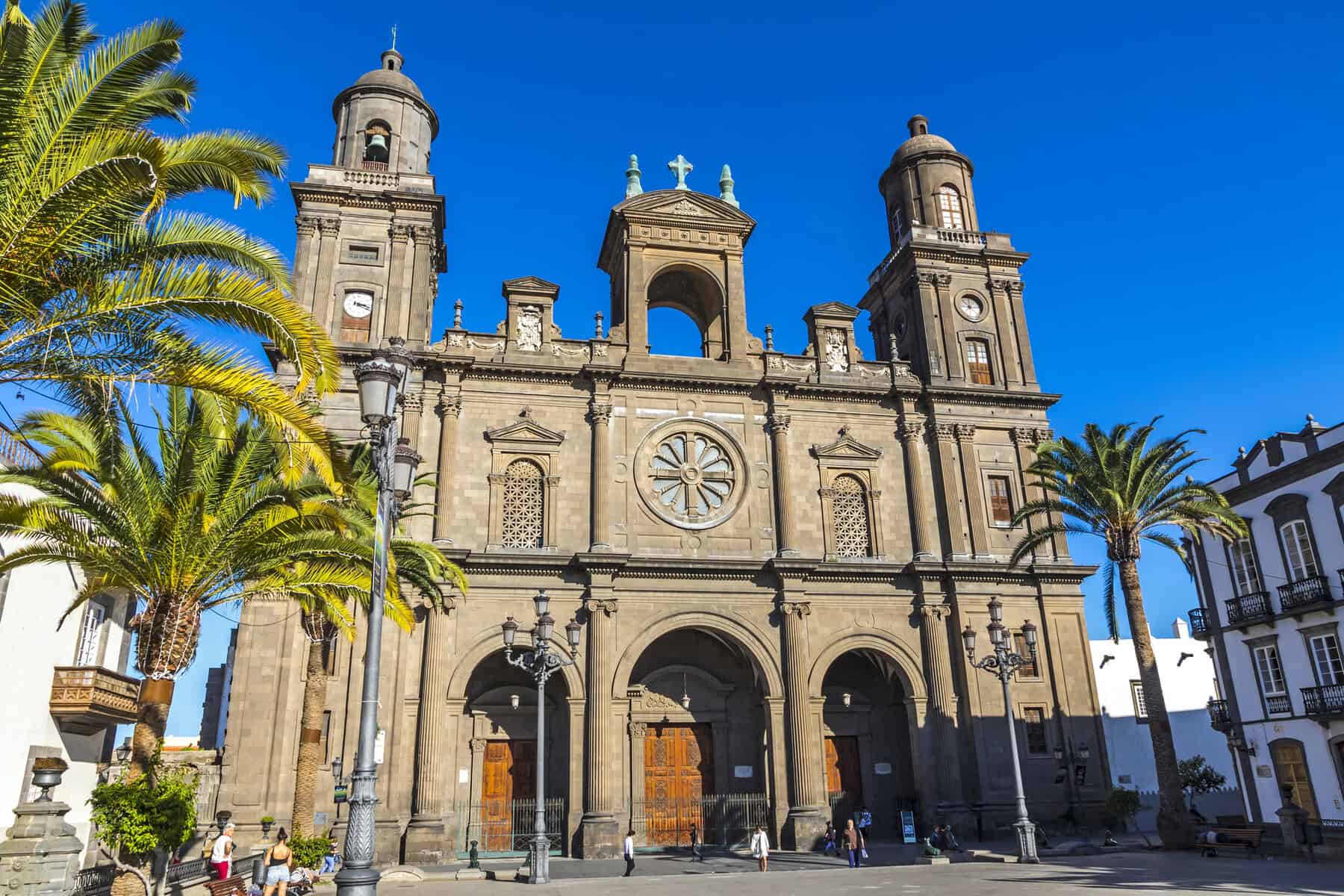
In the plaza, the most significant and eye-catching attraction is the Cathedral de Santa Ana at one end. It’s a magnificent, historical landmark and the oldest (and main) cathedral on the island. It’s so big you’ll need to walk quite far into the square to capture it in full on your camera.
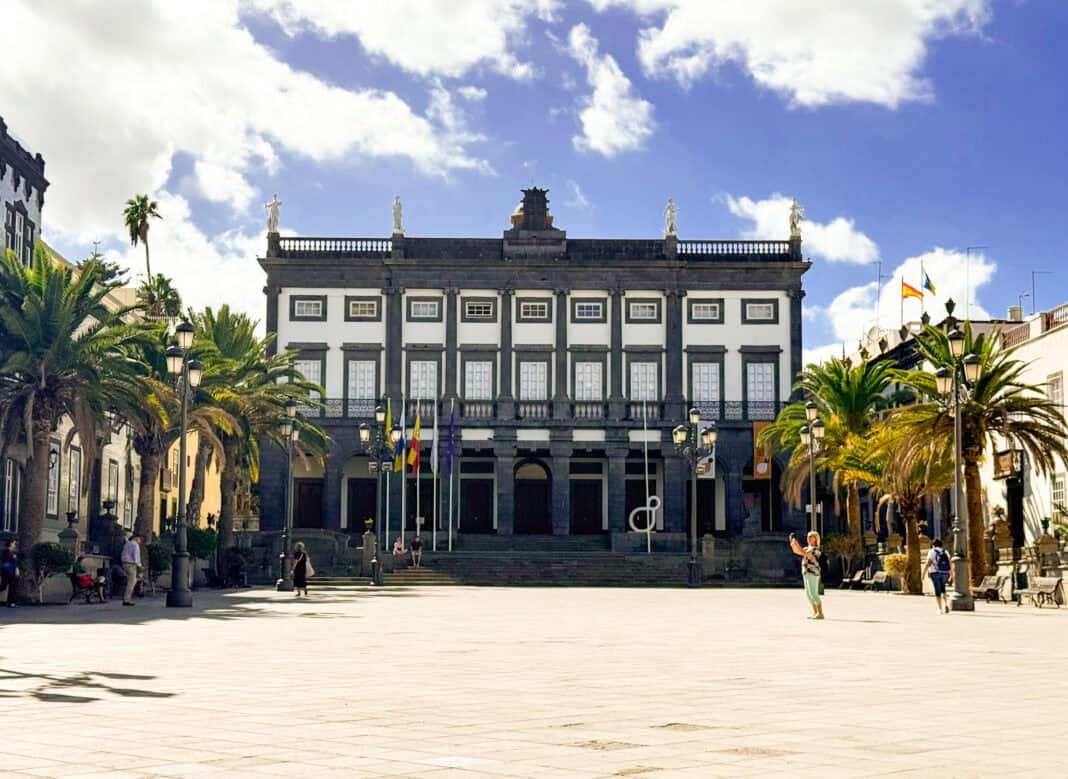
When you do, you’ll be standing near the city’s striking Town Hall, the Casas Consistoriales.
On one side of the square near the cathedral, there is also the fairly modest-looking century Bishop’s Palace (Palacio Episcopal).
Go inside the Cathedral of Santa Ana
If you’ve visited the Plaza de Santa Ana, you will have seen the cathedral from the outside. But I’d really recommend you explore inside as well. You have to pay a small entry fee (6 euros as of November 2025) to do so, but it’s worth it. In my opinion, it’s one of the top things to do in Las Palmas.
If you do explore inside, you’ll find a beautiful and elegant interior. Sleek pillars are on each side of the pews, and there’s a striking vaulted roof. There are also some small, colourful stained-glass windows above the side arches.

Outside, there is a small garden with stairs that take you to a second floor and a small art museum.


The Cathedral’s rooftop
After wandering around these attractions, make sure you go up to the rooftop. This is not to be missed. Even if you don’t like heights, you should be fine, as the main viewing area is wide and you don’t need to stand near the edge.
You can catch an elevator or walk up the stairs to the main terrace. When you arrive, you come out onto a largely open area from where you can look out over the plaza below.
It’s a fantastic view: you can see the entire square with the buildings on either side rising up on the hillsides.

If you’re particularly eagle-eyed, you can also try to spot some of the city’s significant buildings – a map points out the location of these.
You can then walk a few more steps up to one of the towers for yet more views, including of the other side of the cathedral.
Learn about Christopher Columbus in the Casa de Colón
Another main attraction in the old town of Las Palmas is the Casa de Colón – Columbus’ House.
This beautiful colonial building was once the home of the island’s governors and also provided a place for Christopher Columbus to rest during his voyages to the Americas. It’s set around a couple of small courtyards, the main one of which has a pretty garden in the middle.

Inside, there’s a small museum that you can pop into for a few euros. Here, you can see maps depicting some of these voyages, as well as old documents and letters written by Columbus in the late 15th and early 16th century. There’s also a room with reconstructed parts of a ship.
The Casa is only small, so you don’t need to spend much time there. I also thought there could have been a little more information accompanying the various displays inside.
But as the entrance fee is quite cheap (4 euros when we visited in November 2025, and 2 euros for reduced tickets), you’re not losing much by popping inside. It’s open every day from 10 am to 6 pm, except for Sundays when it closes at 3 pm.
If you don’t plan to go inside, I’d still walk over and see the building while you’re in Vegueta. The side by the exit is particularly beautiful, and there’s a small fountain by the side of it.
Sample the local produce in the old Vegueta Market

Not far from the sea, and the Calle Mayor de Triana (one of the oldest streets in the city), is the Vegueta market (Mercado de Vegueta).
This small covered market is a bustling place that sells a wide range of local produce, including fruit and veg, fish, flowers, and cakes. Pop inside if you’re feeling a bit peckish when you arrive.
Admire the Gabinete Literario
The other building I’d suggest you take a quick look at while you’re in the area is the Gabinete Literario (The Literary Cabinet). This is in the Triana area, another of the oldest neighbourhoods in Las Palmas, and is just a street over from the edge of Vegueta.
It’s a really striking building – one of my favourites. It dates back to the mid 1800s and was the first theatre in Gran Canaria. It’s now a private members’ club, but if you fancy going inside, there is a restaurant where you can eat. This has a lovely, covered terrace with outdoor seating at the front.

Relax at the beach
The year-round sunshine on the island makes spending time at the beach a possibility whenever you visit. Even in November, when we visited, the beaches were full of people, and some were swimming in the sea. In the evening, it was still warm enough to take an evening stroll on the sand.
Unlike some of the other resorts in Gran Canaria, the beaches in Las Palmas are urban beaches. But they are still decent beaches, and given their proximity to the main city centre attractions, they offer the benefit of combining a city and beach break.
The main beach in Las Palmas is Las Canteras beach (Playa de Las Canteras).
This stretches for more than 2 kilometres and is fringed by a wide-open pedestrian promenade. Along here, there are lots of bars and restaurants with outdoor seating. So, if you don’t fancy sunbathing or taking a dip in the water, you can sit back and relax with a drink or some local food.
If you do, try the papas arrugadas con mojo (often referred to as ‘wrinkled potatoes’). This is a traditional dish of small, boiled potatoes with a mild red pepper sauce.

Do some watersports
If you’re after something more energetic while you’re at the beach, then there are plenty of outdoor activities to partake in here.
Besides taking a swim in the sea, you can snorkel, or try out some surfing and scuba diving. There are also other beach activities available, but some of these take place in different parts of the island.
As well as Las Canteras beach, there’s also Playa de las Alcaravaneras in Las Palmas. This is the second-longest beach in the city and is also a place to head to for water sports. At this location, you can do some paddle-boarding, canoeing, and surfing. It’s also a popular place for beach volleyball.
Stroll around the largest botanical garden in Spain
Las Palmas’ botanical garden (also known as Jardín Canario de Viera y Clavijo) is a short 20-minute bus ride out of the capital.
At almost 27 acres in size, it is apparently the largest botanical garden in Spain, and is a perfect place for nature lovers. It’s definitely worth spending some time here. You won’t be disappointed if you visit this tranquil attraction.
The garden is free to enter.
Getting to the botanical garden
If you opt to take the bus, it’s around a 20-minute ride. It drops you about a 10-minute walk along the road from the Tafira door entrance to the garden. This is at the top of a steep hill. Once you’re through, you must navigate down a series of steep, narrow steps and follow winding paths to the main sights. Note that there are some warning signs about rockfalls that advise visitors that they continue at their own risk.
So, having recently done this ourselves, we’d recommend (particularly if you have mobility issues) that you take a taxi to the other main entrance (by the Dragonal Road). The taxi wasn’t expensive (we caught one for our return journey).
This also has the advantage of dropping you closer to the main sights in this wonderful botanical garden. It also saves you time if you don’t plan to stay long (realistically, you’ll only need a few hours at most to explore).
Alternatively, you could book a tour which takes you there with the services of a tour guide.
Things to explore in the botanical garden
There are many sections within this amazing garden that showcase different plant species. Some of these are native to the island.
Top of the attractions for us, though, was without a doubt the incredible cacti you’ll see in one particular area. As you wander among these mesmerising plants of all shapes and sizes, you’ll feel you’re wandering through a Mexican desert landscape.


You can also stroll along covered pathways and cross small bridges. Here, you’ll feel you’re more in a forest than the open terrain described above. And in one part, there’s a small lake beside a neat lawn.
You’ll find quite a few unique points of interest in the garden, including a small cave that you can explore inside and stand on top of to admire the views, and some pretty yellow buildings. Also admire the Palm Tree square, a beautiful area full of wonderful palm trees.

Peer through the world’s largest curved aquarium window
Another of the top attractions in Las Palmas is the Poema del Mar aquarium. This is located in the beach area of the city, by the Avenue de Los Consignatarios and close to where the cruise ships come in.
If you’re only on a short break to Las Palmas, this would be a good attraction to combine with a visit to Las Canteras beach. And if you have children, I suspect that it would be one of the top things to do in Las Palmas for them.
The aquarium contains over 550 animal species (marine animals, fish, reptiles, and amphibians) from four seas and oceans, as well as over 2,000 plants from three continents. There are three zones inside: the jungle, tropical, and deep ocean. The latter boasts the fame of having the world’s largest curved aquarium window and one of the largest tanks.
The aquarium is open every day of the year from 9.30 am until 5.30 pm. You can book tickets here.
Visit another museum in the city
Aside from the Casa de Colon, Las Palmas has several other museums you can visit during your trip.
As with Columbus’ House, the Canarian Museum (the Museo Canario) is in the old town in Vegueta, not far from the Cathedral. The focus of this museum is archaeology, with a collection that includes mummies and skeletons.
For art, you can visit the Centro Atlantico de Arte Moderno (CAAM) and the small art museum in the cathedral, and for science, the Elder Museum of Science and Technology.
For more information on museums in Las Palmas, click here.
Go further afield
If you’re staying in Las Palmas and want to plan some day trips slightly further afield, there are options – also in the north of Gran Canaria – that you could consider.
Walk through an old volcano
The Bandama Caldera (Caldera de Bandama) is an old volcanic crater that is over 210 metres deep and has a perimeter of over 3 kilometres.
If you fancy getting out into nature, then you can go to the top and look out over the surrounding landscape. Or if you want some exercise, you can hike to the bottom of the crater.
You can get to the Caldera by bus (number 311) from Las Palmas. This takes about half an hour.
Or you can book tours that will take you there. This tour will take you out to the botanic garden in Las Palmas, with the option to add on a visit to the Bandama Caldera.
This tour takes you to the Bandama Caldera, and includes a meal, a hike to the Roque Nublo, and a visit to the Pico de Las Nieves.
Visit nearby historical towns, such as Firgas
We opted to get out of the city and visit the small village of Firgas during our trip. This is around 30 km from the city. We caught the bus from the central bus station in Las Palmas. It took about an hour, and when you arrive, the town is just a few minutes’ walk from the terminus.
Firgas is the unique and quirky town that you’ll no doubt have seen in guidebooks or on social media. Known as the ‘water town’, it has a main street – the Paseo de Gran Canaria – with running water cascading down steps and some beautiful mosaic seats running along the side.
At the top end, you can cross the small road to another section and peruse a series of huge tiles on the ground that depict the different Canary Islands.


There’s also a small pretty church that you can pop into, and a local museum.
Top tip: If you get the bus, plan your time in advance. Although it’s a charming place and worth visiting, you can see the main attractions in Firgas in a fairly short period of time. So, if (like us), you don’t time things right, you may end up spending a few more hours here than you’d anticipated.
Book an island tour
If you’d prefer to see a lot more of the island, you can book trips that will take you around either the north of the island, or from the north to the south and back in a day.
For the north of the island, you could book this tour. It goes to Arucas, Firgas and Puerto de Las Nieves, to a banana farm (you’ll see lots of these as you’re driving around the area), and also to a vineyard for some coffee tasting and optional wine tasting.
If you want to see more of the island, there are also whole island tours.
This tour starts in Las Palmas, heads out to a ravine, onto the famous dunes in Masopalomas, to Puerto Rico (where you could go out on a boat), and then to Puerto de Mogan, where you get some free time to explore.
Top things to do in Las Palmas
If this trip is your first time in Las Palmas, I hope you have a great time. We really enjoyed our trip (especially the winter sun!) and hope to explore more of the island in future.
If you enjoy visiting Spain on short breaks, you might be interested in some of my other articles, which include:
You can also find articles on my website on other European destinations, including Portugal, France, Switzerland, Germany, and the United Kingdom.