2 days in Seville: the perfect itinerary + must-see sights

Are you planning 2 days in Seville and wondering what the must-see sights are? Or wondering what to put on your itinerary and whether 2 days is long enough?
If you are, then you’ll find all the information you need here: the top sights in this gorgeous Spanish city, an itinerary to cover two days, and practical information to help you plan your trip.
Read on for more information.
This post contains affiliate links
2 days in Seville: the perfect itinerary

This itinerary includes Seville’s must-see sights, while also allowing time to soak up the city’s atmosphere and enjoy the local food.
It focuses on the old quarter on day 1, and the city’s plazas, parks, and riverside on day 2.
If you plan to visit the ‘Aurora’ experience at Las Setas (the Metropol Parasol) during the summer, you may need to reverse the order of the itinerary for your evening on day 2.
Where is Seville?
Seville is located in the Andalucía region of Spain in the south west of the country. It sits inland on the Guadalquivir River, around 120 kilometres from the coast and the Gulf of Cadiz and Atlantic Ocean.
It is around 120 kilometres from Cordoba, and 90 kilometres from Jerez de la Frontera. The capital, Madrid, is further away (around 500 kilometres).
How to get to Seville
Seville has its own airport, which is just 9 kilometres from the city centre.
However, its location also makes it possible to visit the city from other Spanish cities, especially those in Andalucía. Cordoba is around 40 minutes by train, and Jerez de la Frontera is just over an hour.
And even though Madrid is further away, the high-speed train means that it’s still possible to visit Seville in just over two and a half hours.
Malaga, Jerez de la Frontera, and Madrid all have their own airports, so you could fly into these destinations, spend some time there and then make your way to Seville.
Top tip: If you plan to travel by train in Spain, book tickets in advance to avoid disappointment. Also, don’t forget to take your passport or identity card as you need to travel with it.
How to get from Seville airport to the city centre
Seville airport is just 9 kilometres from the city centre, so it’s quick and easy to get in. A shuttle bus runs to the centre, with a journey time of half an hour.
You can also book private transfers if you prefer.
The best things to do in 2 days in Seville
These are the best things to do with two days in Seville. You’ll find further information on all of these below.
Must-see sights & things to do in 2 days in Seville
– Wander through the old quarter, the Barrio de Santa Cruz
– Visit the Royal Palace of Seville
– Snap a picture of the Cathedral’s bell tower from the Patio de Banderas
– Step inside the world’s largest Gothic cathedral
– Climb La Giralda
– Admire the Plaza de España
– Look out over the city from La Setas, the “Mushrooms of Seville”
– Sample the local food on a city food tour
– Wander around María Luisa Park
– Stroll along the river
– Take a riverboat cruise
Wander through the old quarter, the Barrio de Santa Cruz
The Santa Cruz district of Seville is the heart of the city and is probably the main area you’ll spend time in during your two days in Seville.
Once the Jewish Quarter, it’s a charming, vibrant neighbourhood, packed with a labyrinth of narrow streets, and pretty flower-filled squares and courtyards that are a delight to wander through.


As you do this, you’ll pass small shops and boutiques, and scores of cosy, little tapas bars and restaurants. Many of these have outdoor seating where you can sit and watch the world go by.
Depending on the time of year that you visit, you might be treated to the sight of the trees laden down with the famous Seville oranges.
This area of Seville is also the place where you can visit some of the city’s most significant attractions. The Real Alcazar de Sevilla – the Royal Palace – is here, with the Cathedral and La Giralda nearby. In between, is the Plaza del Triunfo, a beautiful square that teems with both tourists and locals, and where you can pick up a horse-drawn carriage ride.
Given the breadth of attractions here, it would be impossible to miss this area. However, I’d recommend allowing yourself enough time to stroll around, soak up the atmosphere and admire the character of your surroundings.
Seville really is a beautiful city, so spend a bit of time just getting to know it.
Visit the Royal Palace of Seville
The Real Alcázar de Sevilla is a royal palace complex in Seville and one of the city’s main attractions. It is a UNESCO World Heritage Site.
Located in the Barrio de Santa Cruz, the Alcazar was developed from a castle into a palace in the 11th century by the Moorish ruler of the day. The new Alcazar was then built by the Spanish in the second half of the 14th century.
As the official residence of the Spanish Royal Family when they visit the city, it is said to be Europe’s oldest “active” Palace. If you’re standing outside the Alcazar, you’ll see the fortress-style walls that encase it.

You can then go inside to marvel at its beautiful buildings. These are a blend of different architectural styles, including Islamic, Renaissance, and Gothic and are very reminiscent of the Alhambra in Granada (albeit on a smaller scale).
Inside the Alcazar
If you purchase a ticket to go inside the Alcazar, you can wander through some of its many stunning rooms and courtyards.
These include the Patio de las Doncellas (Courtyard of the Maidens) with its intricately designed arches and central pool. Another highlight is the Salón de Embajadores (Hall of Ambassadors), with its hemispherical ceiling dome.
Also take a stroll in the beautiful gardens during your visit. These are among the oldest gardens in Seville and contain fountains, pavilions, and shaded walkways.
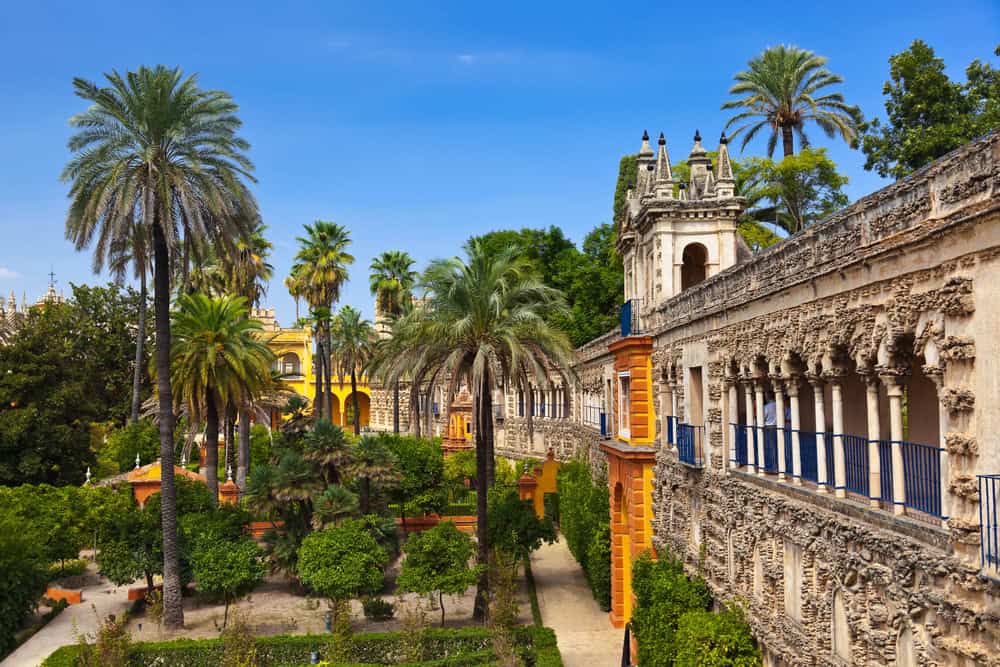
Given its popularity, I strongly advise you to pre-book tickets for the Alcazar. Visitor numbers are limited to 750 per day and, in peak season, entry tickets sell out quickly. You can queue for a ticket on the day, (very early in the morning), but this still does not guarantee you entry.
Top tip: if you don’t manage to get tickets to the Alcazar, there are other (smaller) attractions in the city where you can visit a Moorish-style mansion: for example, the Casa de Pilatos. Or maybe just put aside a visit to the Alcazar for a return trip to Seville!
Snap a picture of the Cathedral’s bell tower from the Patio de Banderas
This wide open plaza is just off the Plaza del Triunfo and adjacent to the Alcazar. It’s actually part of the Alcazar, but you can go in for free, even if you’re not visiting the Palace.
Once a former parade ground, the Patio has a big open area in the middle which is surrounded by orange trees and beautiful buildings. It spans over 1400 square metres
It’s worth going inside, even if only briefly. You’ll get a fantastic view of the Cathedral’s bell tower from here.

Step inside the world’s largest Gothic cathedral
Dating back to the early 15th century, Seville Cathedral (the Catedral de Sevilla) is one of the leading attractions in Seville’s old town. Situated on the site of a mosque built by Moorish rulers in the 12th century, it is the largest Gothic Cathedral in the world.

From both the outside and inside, it’s not difficult to see why this is the case: it’s enormous.
It’s impossible to miss this historically important building as you walk around the surrounding streets in the city centre – and when you walk inside, you’ll be wandering around a cavernous interior which spans more than 11,500 square metres and has 80 side chapels. The Cathedral also houses the tomb of Christopher Columbus.
An entry ticket gives you access to the main cathedral, as well as to the Giralda bell tower, which you can climb. You can also walk outside into the Patio de los Naranjos (the Courtyard of Orange Trees).
This is a beautifully peaceful open space where you can snap some great pictures of the Giralda tower framed by the orange trees.

You can book tickets to Seville’s Cathedral here.
You can also book tickets that provide access to both the Alcazar and the Cathedral.
Top tip: If you plan to go inside the Cathedral, it’s advised that you book tickets in advance. The queues can be quite long. If an audio guide comes with your ticket, check whether you need to supply your own headphones: we found this was not the case with all tickets.
Climb La Giralda

If you’ve bought a ticket for the Cathedral, then you also get the opportunity to climb the Giralda.
This is the beautiful tower that is impossible to miss when you wander around the old town. It’s one of the iconic landmarks you’ll see on Seville’s skyline.
The Giralda is over 100 metres high and, like Cordoba’s bell tower in the Mezquita-Catedral, it was originally a 12th-century minaret for a mosque.
I’ve read that its design drew on that of the Koutoubia Mosque in Morocco’s Marrakech. If you’ve been to Marrakech, it’s easy to believe this.
You can climb to the top of the Giralda. There are 24 bells inside what is a more recently constructed 16th century belfry.
Climbing the tower
The climb to the tower takes about 20 minutes. You may have to queue to start this, but fortunately for us, the queue moved quite quickly.
The other good news is that most of the climb is up sloping ramps, rather than steps: it was designed in this way to ensure that the early visitors could reach the top on horseback.
The only section where you’ll need to climb up steps is right at the very top when you enter the belfry. There are also small alcoves along the way where you can have a rest and get your breath back. You can peer out the windows from these to see parts of the city.
Once you arrive at the belfry, you’ll see the bells hanging down above you. You can then walk around the sides and step up into the recesses to take in the fabulous views from this height.
Should you climb the Giralda?
I’ve seen people asking whether a climb to the top of the Giralda is worth it. This is really a matter of personal choice.
On the one hand, it’s an easier climb than I had expected. Walking up a series of sloping ramps rather than steep steps makes the experience much more enjoyable and less tiring on the legs (for me, at least), and you can reach the top in around 20 minutes.
The Giralda is also one of the most significant sights in Seville, so you may feel you’re missing out if you don’t make the ascent.
On the other hand, the climb is still in enclosed spaces, and it can get quite crowded. When we arrived at the top, it was particularly crowded, especially when trying to step up to the windows to admire the views.
Considering the great height, the windows are understandably barred, but this makes it difficult to take any unobstructed pictures.
Admire the Plaza de España
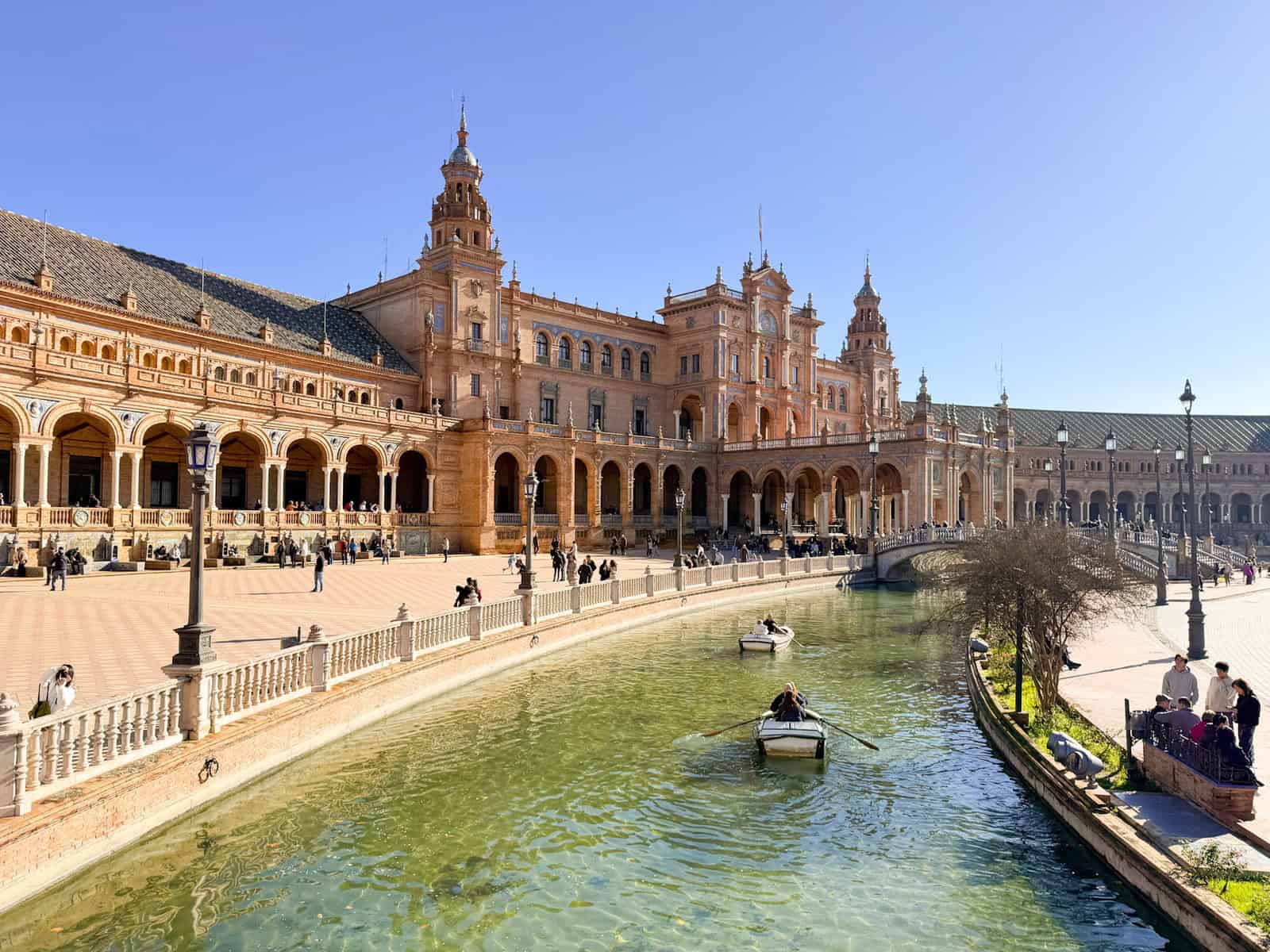
A visit to the Plaza de España is a must when you’re in Seville. It is about a 20 to 25 minute walk south of the old town and is free to visit.
Built in the late 1920s for the Ibero-American Exposition, the plaza is a huge sweeping semi-circle that is nothing short of spectacular.
There is a wide-open space with a central fountain and small canals around the edges, straddled by beautiful bridges. If you have time, you can sail along these canals.
Grand buildings with covered walkways frame the back of the circle, and are book ended with majestic towers.
I’d advise standing back and admiring the magnificence of the plaza before you start exploring it. There are also several sections where you can climb steps to a balcony, which offers a fabulous view looking across and over the plaza.

You should then spend a bit of time wandering around and admiring some of the finer details of the plaza. You’ll spot the sheer amount of beautifully coloured tiles dotted around. They’re everywhere – on walls, balconies, floors, balustrades, steps…in total, there are said to be more than 7,000 ceramic tiles here.
These tiles also cover the alcoves lining the back of the plaza beneath the arches. As you walk around these, you’ll spot they all have different city names.
After visiting, I learnt that each one represents a different region of the country.

Top tip: the open plaza is very exposed in summer. However, you can escape the sun and heat by walking under the arches in the plaza or heading for the shaded sections of the Maria Luisa park that is adjacent to it.
Look out over the city from Las Setas
Las Setas (or the “Mushrooms of Seville” on account of its shape) might be one of the more modern attractions in the city, but it is nonetheless one you should put on your itinerary. We loved it when we went after dark, which is arguably the best time to visit.
Officially the Metropol Parasol, it’s a huge contemporary structure that rises above the Plaza de la Encarnacion. Opened in 2011, it’s the world’s largest wooden structure and features a viewing platform from which you can look out over the city.

The design was part of a competition to regenerate the immediate surroundings. That said, a local we spoke to said that it had not been entirely welcomed. When you see it, it’s not difficult to see why. It’s probably not for everyone, and it took several years to complete.
But equally, when you see it for yourself up close, it’s a unique structure that, in my opinion, you can’t help but admire – and the views you are afforded from the platform are incredible.
The viewing platform
To say that Las Setas has a viewing platform is downplaying it a bit.
The ‘platform’ is, in fact, a secure, open-air walkway that weaves across the top of the wooden structure. As you make your way along this walkway, you’ll get the opportunity to look out over Seville from multiple vantage points.
You access it via a lift from an underground entrance.
You can buy tickets for it here.
The Aurora
Las Setas is open for visitors from 9.30 am until half past midnight. If you go at sunset or after dark, you’ll get to experience the Aurora.
Billed as an “immersive experience”, the Aurora is a light show that sees Las Setas bathed in an array of changing colours. You can watch these as you make your way along the walkway.
The colours, coupled with the twinkling lights of Seville below, make it a really magical experience.

Top tip: when you visit Las Setas, don’t miss the ‘Feeling Sevilla’ film that is screened in a small cinema on your way out. This short film explores different aspects of Seville’s culture using sight, sound, and smell. There is also a museum in the basement which houses archaeological relics unearthed at the site.
Try the local food
For me, part of discovering a new destination is sampling the local food. Seville has so much to offer on this front.
When you wander around the centre, particularly the Barrio de Santa Cruz, you’ll pass so many enticing tapas bars and restaurants. Many of these have outdoor seating so you’ll be able to work up an appetite as you see the large variety of dishes put out on the tables.
Seville food tours
There are lots of restaurants and bars in Seville that you can choose from.
However, if you really want a taste of Seville while also learning about the city and its history, I’d recommend booking a food tour. We did this on our trip and thoroughly enjoyed the experience.
We booked this tour, and I can’t recommend it more highly. Our guide Remy was incredible. We were taken to four different establishments, all a short walk from each other, and given a drink (or two!) and some small plates in each.
We got to try a variety of hot and cold dishes. These included montaditos (small sandwiches), salmorejo (a cold Andalucian tomato soup seen on a lot of menus), Spanish tortilla, espinacas con garbanzos (a warm spinach and chickpeas dish), cold-cured meats, some fish, and some cheese.


We also sampled some local wine and sherry, with a closing tipple of Seville orange wine.

All this was accompanied by fascinating local information and funny stories, and a feeling of having experienced a lot more in a short time than we could ever have achieved with a quick lunch or evening meal in just one restaurant.
You can book the tour we took here.
To explore other food tours, click here.
Wander around María Luisa Park
If you’ve spent time in the Plaza de Espana, you’ll be inside the Maria Luisa Park (Parque de Maria Luisa de Seville). It’s therefore worth adding on some extra time to wander around it.
The park is beautiful. Away from the hustle and bustle around the Plaza de Espana, you’ll find a peaceful place where you can largely escape the crowds. The treelined walkways also provide welcome shade from the heat after time spent in the open plaza.

You can wander along the paths, past small lakes, fountains, and pavilions. On the day I visited, there was very little noise, aside from a few children squealing at the ducks swimming in one of the lakes and the sound of horse-drawn carriages taking people on rides.


The park also contains the Archaeological Museum of Seville. This is in the Plaza de America at the other end of the park.
Stroll along the river
Part of the Maria Luisa park runs along the side Seville’s river, the Guadalquivir. So if you’re in the park, this would be a great opportunity to take a walk along the waterfront.
Walk towards the Puente de Isabel II along the wide, modern promenade. As you stroll along, you’ll get views over the river and to the opposite riverbank in the Triana district.

At times, you’ll see tourist boats sail past and a few kayakers. There is also a smattering of bars and restaurants along the way with outdoor seating if you fancy stopping off.
The Torre Del Oro
About halfway along this riverside walk, you’ll get to the Torre del Oro. Otherwise known as the Tower of Gold, you can’t miss this sleek tower that stands 36 metres high on the side of the river.

Dating back to the 12th century, it was once part of the city wall and apparently takes its name from the ships that used to offload their gold here. It now houses a small maritime museum that has views across the river.
From the Torre, you can continue along the river and then climb the steps that will take you up a level. You can then cross the road and go back into the old town.
Triana
If you don’t want to head back to the old town at this point, you can continue along the river. There are places where you can stop for a drink or a bite to eat.
On this side of the river, there’s also the Mercado del Barranco by the Puente de Isabel II. This is a great indoor venue where you can choose from an array of different food and drink outlets.
You could also cross over the bridge here to the other side of the river and the Triana neighbourhood. There are bars and restaurants here, as well as the local market – the Mercado de Triana – which also contains some small eateries.
Take a riverboat cruise
While you’re by the river, you could also hop on a boat and ride along the Guadalquivir River. There are places where you can do this, not far from the Torre del Oro.
A boat ride is a great way to see some of the city sights in a more relaxing way, and you can choose the amount of time you want to spend on them.
Some tours last just an hour and take you along the river, under bridges, and up to the Seville Expo ‘92 building. Others last a bit longer and include tapas or lunch or dinner.
Or, if you’re feeling a bit more adventurous, you could go paddleboarding or kayaking!
What to do if you have more time in Seville
If you are lucky enough to have more than 2 days in Seville, there are plenty of places you can visit on a day trip.
Among these is Cordoba, a city about 40 minutes away by train.
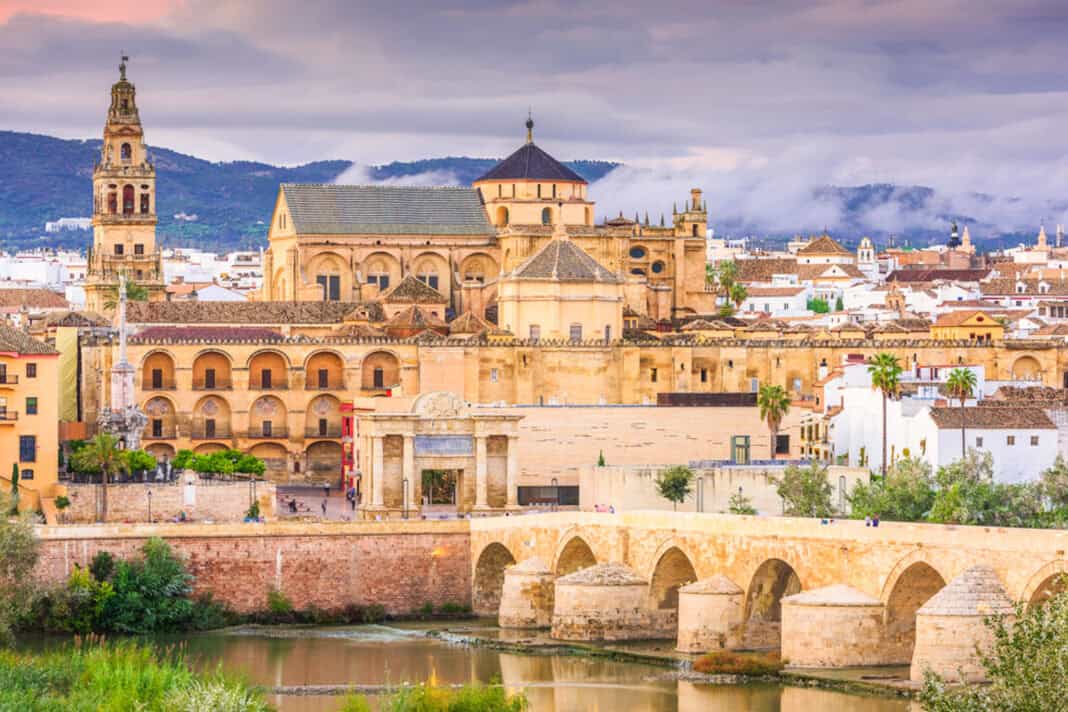
Famous for its unique Mosque-Cathedral and three UNESCO World Heritage sites, it’s a fabulous day out. Aside from visiting the Mosque-Cathedral, you can explore the old town and Jewish Quarter and visit the city’s Alcazar.
You can read more about the top things to do in Cordoba here.
Jerez de la Frontera is another top day trip from Seville. Located in the ‘Sherry Triangle’ of south-west Spain, it’s one of the leading places to sample sherry.
Jerez is also famous its Andalusian horse show, and for flamenco, so there’s lots to do here! Read more here.
If you fancy a trip to the beach, you could also head out to Cadiz. This is about an hour and a half by train, a few train stops past Jerez.
And if the palaces of Seville and Cordoba have given you a taste for visiting historic buildings, you could also go across to Granada (about two and half hours by train) and explore the outstanding Alhambra Palace.
2 days in Seville: Frequently Asked Questions
Yes, two days in Seville is definitely long enough to cover the city’s main highlights. There’s a lot to do here, but not so much that you’re likely to feel rushed. In my opinion, 2 days in Seville is a good length of time for first-time visitors: you can see the main sights, get a feel for the city, and then decide if you want to return to explore more.
How many days you have in Seville really depends on the pace at which you want to see the sights. With two days in Seville, it’s possible to see the main sights and get a feel for the city. However, if you have a little longer, you can sightsee at a more relaxed pace and potentially add on a day trip or two outside of the city.
The must-see sights in Seville are:
– The Real Alcázar de Sevilla
– Seville Cathedral and La Giralda
– The Plaza de España and the Maria Luisa Park
– Las Setas (the Metropol Parasol)
– The Barrio de Santa Cruz old town quarter
Yes, Seville is very walkable. The main sights are located close to one another, so it’s easy to get around on foot.
If you prefer, however, there are hop-on hop-off buses that you can book that will take you around the city’s main landmarks. We also found that Ubers were very cheap, so we sometimes used these in the evening. Public transport wise, the city has a metro and a network of trams and buses that you can use to get around.
Yes, it is strongly recommended that you book the Alcazar in advance. The number of people that can enter per day is strictly limited, so if you don’t pre-book, you may be disappointed.
You can book tickets for Seville’s Alcazar here.
Seville offers a wide range of accommodation to suit all tastes and budgets.
We stayed in the Hotel Giralda Center and were extremely happy with it. The hotel was ideally located – very close to the Plaza de Espana and about a 20-minute walk into the old town. It has a bar and restaurant, and a small pool on the roof. It also offers a fabulous breakfast!
If you’re planning to stay longer than 2 days in Seville, there are plenty of options for day trips. Among these are:
– Cordoba: a chance to visit the famous Mezquita-Catedral
– Granada: for visiting the bucket-list Alhambra Palace
– Jerez de la Frontera: one for sherry and horse lovers!
Cadiz: for some coastal fresh air
2 days in Seville
If this is your first time in Seville, I hope you enjoyed it as much as we did.
For ideas for other short breaks in other European cities, see my website.