Is the Charles Dickens Museum in London worth visiting? A guide for visitors
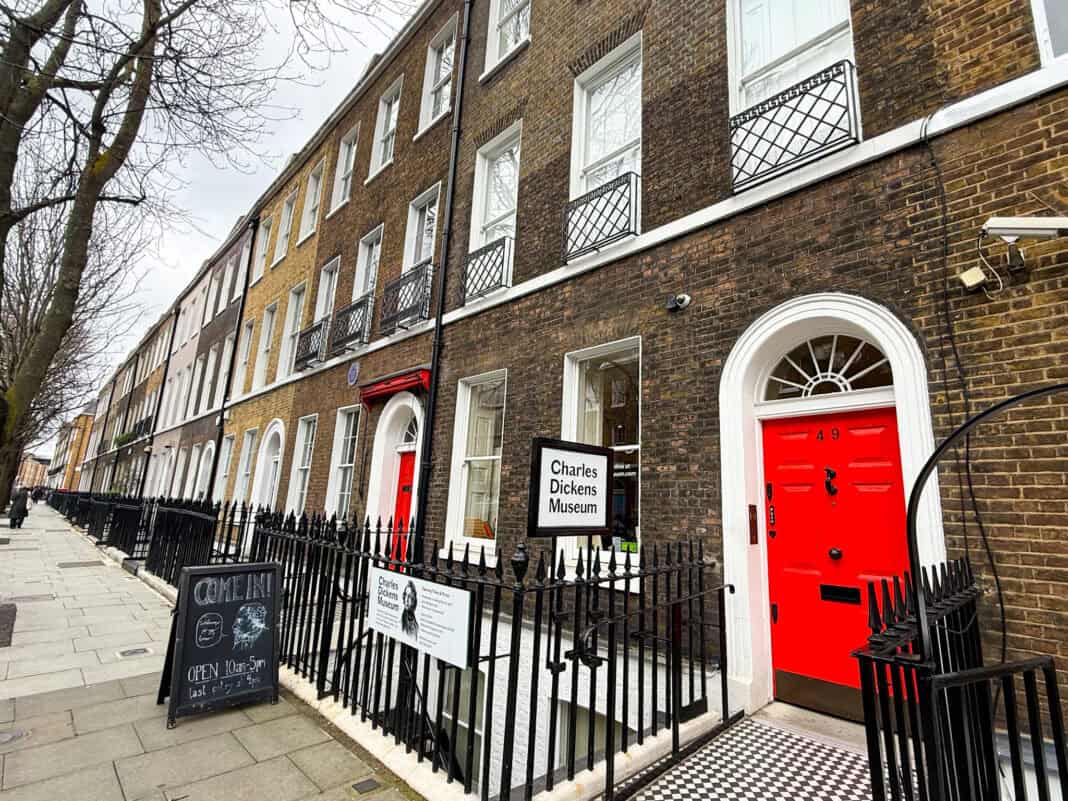
The Charles Dickens Museum in London is set in a Georgian townhouse, in his Doughty Street home. He lived here in the late 1830s, shortly after marrying his wife Catherine, and wrote several of his famous works here, including ‘The Pickwick Papers’, ‘Nicholas Nickleby’, and ‘Oliver Twist’.
If you’re planning a trip to London, you might be thinking about visiting the museum. But you might be wondering if it’s worth the stop: what there is to see inside, whether it’s of interest, and whether it’s easy to get to.
Having recently visited the museum, here’s what you can expect – and whether this small museum deserves a place on your itinerary.
Towards the end of the post, you’ll also find some practical information on a visit to the museum, including how to get there, opening times, and how long you’ll need for your visit.
This post contains affiliate links
The Charles Dickens Museum in London
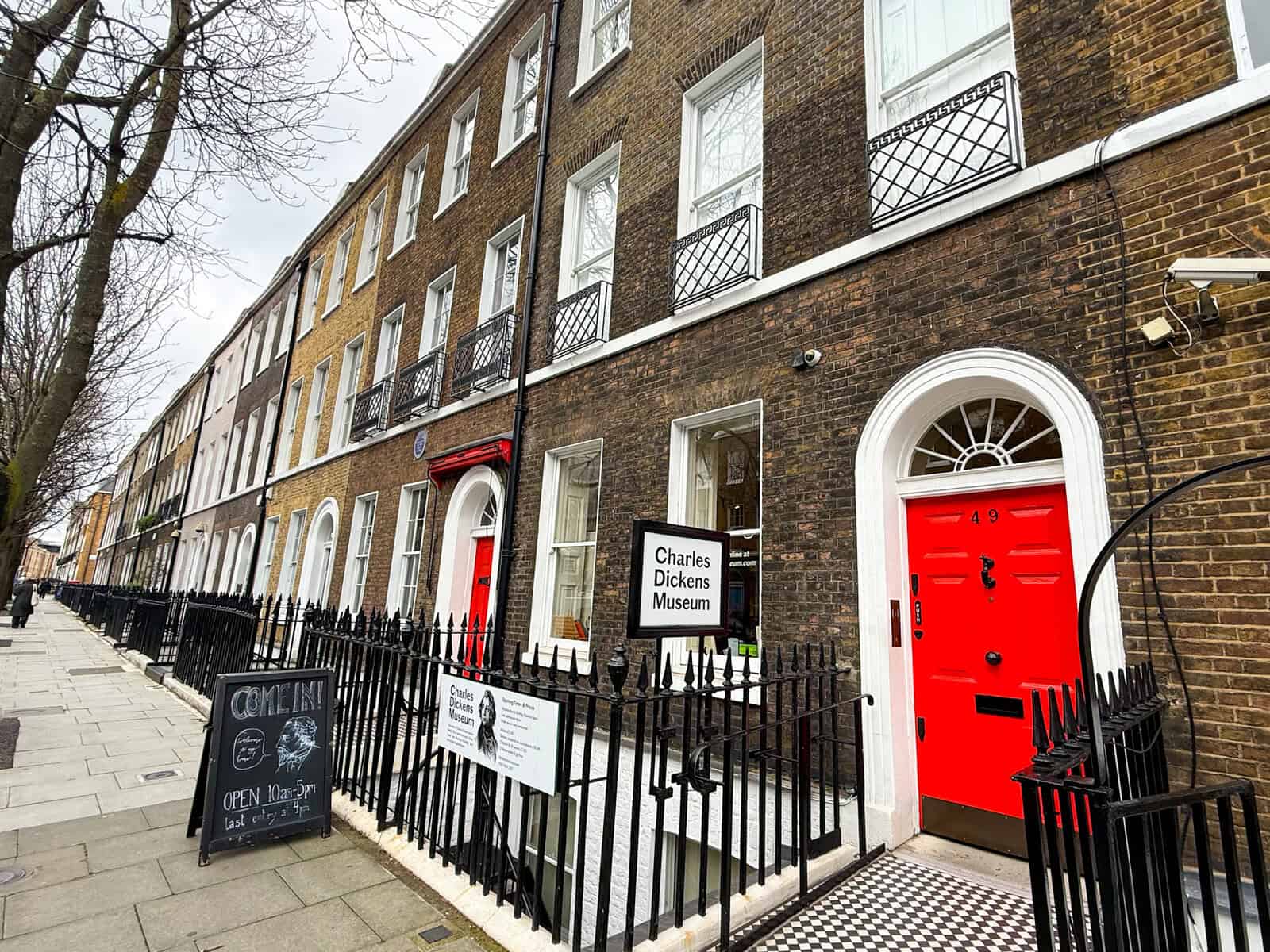
The Charles Dickens Museum is located at 48 Doughty Street, the only surviving house in London where Charles Dickens lived as an author.
Given that he apparently lived in no fewer than 22 places in London, this is quite significant! It was also in this house that he went on to achieve international fame.
The house is preserved as a museum dedicated to Dickens, with period-style rooms restored to the Victorian style of the day (Dickens moved into the house in 1837, the same year Queen Victoria came to the throne). Inside, you’ll find a superb collection of personal artefacts displayed across five floors, many of which are original items.
As the museum is in one of the Dickens’ family homes, it’s only small. But if you’re a fan of this great novelist, or enjoy exploring old historic houses, this is one for you.
Its size means you can look around the property relatively quickly, and its location makes it easy to combine a visit with a trip to other nearby London museums, such as The British Museum.
Entry to the Charles Dickens Museum in London
There is an entry fee to see the Charles Dickens House (see below for more details).
However, if you have purchased the London Pass, you can get in for free.
The London Pass
The London Pass helps you save money on your London trip
The Pass gives you access to more 100 London attractions. These include the Tower of London, The Shard, Westminster Abbey, Kensington Palace, St. Paul’s Cathedral, & the London Eye
It also includes free entry to the Charles Dickens Museum
You can also get a hop-on hop-off bus and boat ride & access to attractions outside London such as Windsor Castle
You can purchase The London Pass here
Is the Charles Dickens House in London worth visiting?
If you’re a literature lover or a fan of Dickens, you’ll find this museum fascinating. Not only can you wander around and see rooms that are set up as they were when he lived in Doughty Street, but there’s lots of really interesting information to learn about his life.
However, the museum is only small, so if you’re expecting a collection on the scale of other London museums – such as the Victoria and Albert Museum or the Natural History Museum in South Kensington – you might be disappointed.
That said, the museum’s size means you can quickly slip in a visit, even if you’re only in London for a few days. It’s near enough to some of the other top London sights to do this – and if entry is free as part of your London Pass, it’s worth putting it on your itinerary.
If you are planning to visit, read on to learn more about what you can see inside the museum and for practical information to help you plan your time.
And if you fancy learning more about Charles Dickens and some of the significant places in London in his life and novels, you can book dedicated walking tours.
What can you see inside the Charles Dickens Museum?
The Charles Dickens Museum spans five floors with rooms that showcase various aspects of the Dickens’s home and family life, as well as his life as a young man, and later as a writer.
The museum’s collection includes some of the original furniture owned by Dickens, a large number of paintings, as well as an array of personal effects. There are also extracts of some of his famous works dotted around. This includes Dickens’ earliest surviving piece of writing.
The basement
When I visited, I was advised to start in the basement and work my way up through the house. The basement rooms are those that were important to the household’s functioning: the kitchen, wash house, and preparation room. In them, you’ll see cooking implements, a simple table laid out for eating, and the wash-house copper.
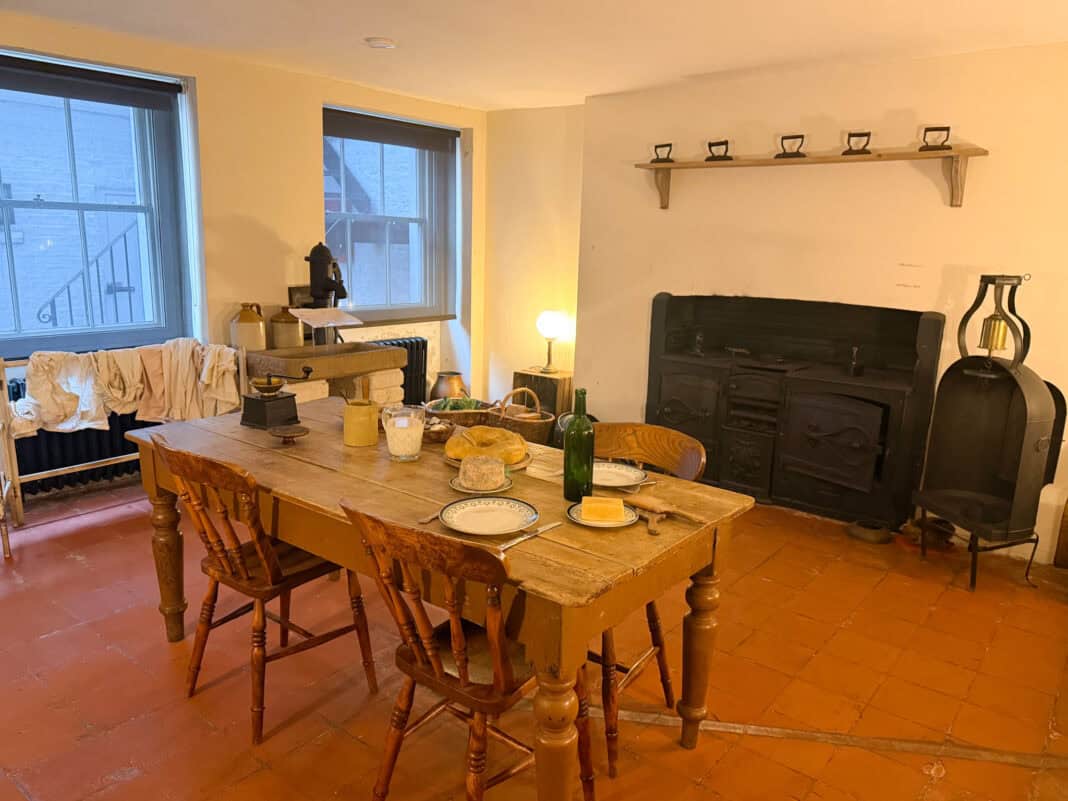

The information provided in the rooms flags that the copper was essentially a precursor to our current-day washing machines. However, it was also apparently used at Christmas for boiling Christmas puddings, a tradition described in ‘A Christmas Carol’, the relevant extract from which is displayed beside the old copper.
The ground floor
On the ground floor, you can wander into the morning room and dining room. These grand rooms are adorned with portraits, including one of Dickens himself.
The dining table is set out as it might once have been when the family entertained here.


The first floor
Moving up the stairs, you come to the first floor. The rooms on this level display artefacts which focus more on the work of Dickens than his family life.
In the study, there’s Dickens’ writing desk and chair. This is the desk that he worked on in a later home in Gad’s Hill Place in Kent, and from where he wrote works that include ‘Great Expectations’, ‘A Tale of Two Cities’, and ‘Our Mutual Friend’. There’s also some of his original manuscripts and handwritten drafts here.

And then in the larger drawing room, there’s a sofa and a reading desk. The desk was designed by Dickens and was from where he delivered some of his public readings.
The second and third floors
The second and third floors of the museum are more concerned with the household’s sleeping arrangements. On the second floor, there are two rooms with four-poster beds in them and more original furniture.

In the couple’s bedroom, there are some artefacts and documents relating to their separation in 1858. In the Mary Hogarth room, others relating to his illness and subsequent death in 1870, including his will, are on show.
A small dressing room on the second floor also displays some of Dickens’ personal items for grooming.
And then on the third floor, you’ll find the children’s nursery and sleeping quarters for the servants who worked in the house. In one of these rooms, there are more extracts from some of Dickens’ famous works, among them ‘Hard Times’, ‘David Copperfield’, and ‘A Tale of Two Cities’.

In another room, there is information on the early life of Dickens. This sets out how, from a comfortable family life in Kent, his father ended up in the Marshalsea, a debtors’ prison, and how this ultimately led to Dickens needing to work in a factory when he was 12 years old.
There is also a small letter on show. This is said to be Dickens’ earliest surviving piece of writing.
Special exhibitions
When I visited, parts of the second and third floors were dedicated to a special exhibition labelled ‘Extra/Ordinary Women’. The exhibition highlighted many of the women in Dickens’ life: the roles they played, how he portrayed them in his novels and other works, and how the Victorian values of the day influenced this.
There are pictures, letters, and books, plus narrative (and a 40-minute video) that provide fascinating information about the women. There is information on his wife, Catherine Dickens, and the support she provided throughout their marriage. The well-known affair Dickens had with the actress Ellen Ternan is also acknowledged.
But a lot of the detail is about the arguably lesser-known women in his life. As the board at the start of the exhibition states:
Behind Charles Dickens…there were many great women supporting and inspiring him…Dickens knew plenty of extraordinary women, including in his own family. These women are regularly ignored in the history books but in this exhibition, we’re going to bring their stories to light
It’s only small, but the exhibition is worth spending some time in. It runs until September 2026. Given that the website highlights past exhibitions, it may be that if you miss this one, there’ll be another running when you visit.
Practical Information for your visit to the Charles Dickens Museum in London
If you’re considering visiting the Charles Dickens Museum in London, you’ll find some practical information below to help you plan this.
Where is the Charles Dickens Museum in London, and how do I get there?
Located at 48-49 Doughty Street in central London, the Charles Dickens Museum is ideally located for sightseeing, especially if you plan to visit other museums during your visit.
The British Museum is about 10 minutes away on foot, and the Postal Museum is just a few minutes away. St Paul’s Cathedral can also be easily reached from the house.
The nearest underground station is Russell Square, which is on the Piccadilly Line. This is just a 5-minute walk away.
Chancery Lane tube station (on the Central Line) is also not far – around a 10 minute walk. King’s Cross and St. Pancras stations are 15 minutes away. Although these are a little further away, more tube lines serve these stations, including the Victoria Line, Northern Line, Circle Line, and Metropolitan Line.
Opening times for the Charles Dickens Museum London
The museum is open from Wednesday to Sunday from 10 am until 5 pm. Last admission is at 4 pm.
Entry fees for the Charles Dickens Museum
Entry is currently £12.95 for adults and £7.95 for children over 6 (children under 6 go in for free).
There is free entry to the museum for holders of The London Pass.
What else is in the museum for visitors?
There is a small café in the museum (aptly named the Artful Tea Room!) where you can grab a quick drink and a snack. There are toilets in a couple of places on the stairwells.

The museum also has a small shop where you can buy souvenirs.
How long should I set aside for a visit here?
The Dickens House Museum is small, so you only need to set aside a short time for your visit.
If time is tight, you could easily explore it thoroughly in an hour or an hour and a half, with extra time added on if you fancy stopping off for a drink and a snack in the cafe.
Accessibility
The museum offers reduced entry fees for visitors over 60, students, or anyone who is disabled or on Universal Credit. There is also free entry for carers who are escorting a ticket holder.
Although the museum is set over five floors, which are reached by a main staircase, there is also a lift for use. This provides access to all floors, except the very top one. There is an accessible toilet on the ground floor.
The museum’s website provides more detail on accessibility here.
Provision of information
There is brief written information throughout the museum.
There are also QR codes you can use to access audio guides using the museum’s Wifi (make sure you bring your own headphones).
Where else can I learn about Charles Dickens in London?
If you fancy learning more about Charles Dickens and some of the significant places in London in his life and novels, you can book dedicated walking tours.
Browse available Charles Dickens walking tours here.
You can also pick up an information leaflet in the museum, which sets out a self-guided walking tour of central London with the key sites marked on it.
Other things to do in London
If you’re looking for information on other things to do in London, I have a range of posts for you!
If you’re visiting for the first time, check out my guide to the 10 unmissable things to do for first-timers. I also have a post on free things to do in London to help you budget for your trip.
If you’re looking for romance in London, there’s plenty to do here. And if you fancy spending time in some of fantastic parks and gardens, you can see the range on offer here.
I also have guides on specific attractions and areas in London. These include on: